

Lucas Thomae, Carolina Public Press
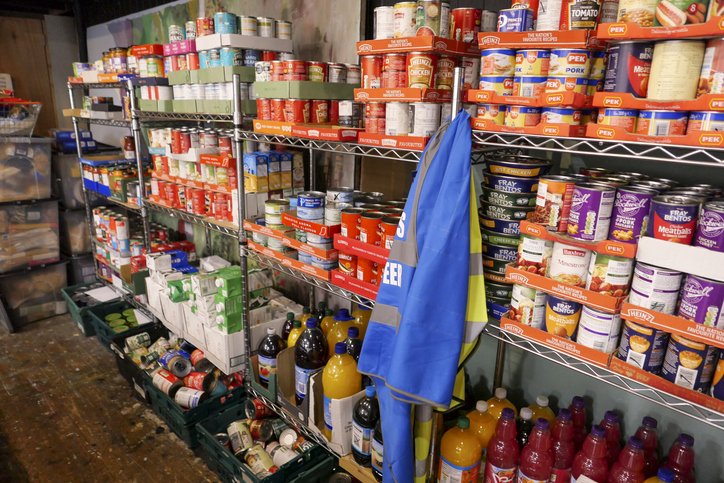
For those seeking food assistance in Chatham County, visiting a CORA food pantry feels more akin to shopping at a grocery store than rummaging through a warehouse.
CORA, which is an acronym for Chatham Outreach Alliance, operates two choice pantries in Pittsboro and Siler City. A choice pantry means that visitors are able to select what they want, rather than receiving a pre-packaged bundle of food.
After filling out an intake form and receiving a membership card, visitors get a shopping cart and are assisted by volunteers who guide them through the pantry. Fresh produce is stacked on display tables. Refrigerators are stocked with high-demand commodities like meat and eggs. Ready-to-eat foods like bagged salads and bakery and deli items are also available, having been donated by local retailers.
In the lobby, next to a kids play area, recipe cards in both English and Spanish offer suggestions for how to use in-season produce. Currently on the menu is a collard green coleslaw, sweet potato wedges and lentil tacos.
According to CORA executive director Melissa Beard, more people are using the food pantry than ever before. This summer, CORA served 1,695 children through its program which feeds students while school is out of session. That was a 17% increase compared to last year, Beard said.
In addition, the number of new families who received food from CORA grew from 922 to 1,636 during the most recent fiscal year. Part of that growth was expected since CORA opened its second location in Siler City at the end of 2025.
But the severity of that spike, combined with the increased utilization of its summer food program, pointed to a more worrying trend of growing hunger in the county. And the trend isn’t just localized to Chatham. Food pantry leaders told Carolina Public Press that food insecurity is becoming more common statewide due to rising prices, not just at the grocery store but in all areas of life.
“We’re seeing a lot of people make very hard decisions around making sure their kids have food, and they may not eat as a result of that, or having to pay for medicine, and therefore they can’t afford food, or having to choose between transportation and food,” Beard said.
“And it’s just the economy and inflation that’s driving so much of it.”
Development and communications director Rebecca Hankins said many of the people she speaks with at the food bank are increasingly anxious about their finances, particularly seniors.
One woman told Hankins that she was “devastated” about how little her money lasts in the grocery store these days.
“It used to be that if she had $60 for the week, she could manage,” Hankins said.
“But now, $60, if you buy meat a third of your budget is gone.”
Hunger a growing problem in NC, food banks say
Jason Kanawati Stephany, a vice president at the Food Bank of Central and Eastern North Carolina, didn’t mince words when describing the current state of hunger in the areas served by the food bank.
“Our communities are facing the worst hunger crisis that we’ve seen in at least a generation,” he said.
The Food Bank of Central & Eastern North Carolina is one of the largest hunger relief networks in the nation, with partners in 34 counties in North Carolina, including Chatham. Last year, the food bank distributed 96 million meals across its service area.
According to Kanawati Stephany, currently 180,000 more people are facing hunger in Central and Eastern North Carolina than did so during the peak of the COVID-19 pandemic.
The reasons for the increase are layered, and many families have unique reasons why they are struggling to put food on the table. It could be that one or more adults in the home are out of work, or that despite working their incomes aren’t matching the rising costs of groceries, housing and healthcare. Some in rural communities lack the transportation necessary to consistently access food.
“All of these factors are different depending on the community, but the throughline is that people are doing everything that they can to make ends meet, and the math just isn’t working,” Kanawati Stephany said.
Prices aren’t just affecting people at home, but straining food bank budgets as well.
Rising diesel prices brought about by the War in Iran have made it more difficult to fuel the fleet of trucks operated by the Food Bank of Central & Eastern North Carolina. And when an outbreak of avian flu sent egg prices to record highs, they simply disappeared from the shelves of many food pantries.
Cuts to federal programs meant to address food insecurity have also exacerbated the problem, Kanawati Stephany said.
Two of those are the Emergency Food Assistance Program (EFAP), which distributes food to families who meet income eligibility requirements, and the Local Food Purchase Assistance Cooperative Agreement Program (LFPA), which issues grants to schools and food banks to purchase produce from local farms.
Kanawati Stephany recalled that in April of 2025, the U.S. Department of Agriculture canceled 90 truckloads of food supplies destined for North Carolina in response to the cuts. Federal support has trickled back over the course of the past year and a half, but shipments of food supplies originating from those programs have become “incredibly unpredictable,” he said.
Gap between haves and have-nots in Chatham
Chatham County, in many ways, is a microcosm of how food insecurity is playing out statewide.
By per capita income, Chatham is the wealthiest of all 100 North Carolina counties, and parts of it are growing quickly, particularly in the east. In 2023, The Walt Disney Company announced plans to build a 4,000-home residential living community in Pittsboro, touting its proximity to the Research Triangle.
That growth focused in eastern Chatham isn’t reaching all parts of the county, however. The western parts of the county are more rural with significant pockets of poverty. Unsurprisingly, these areas are also the epicenter of Chatham’s hunger crisis.
“It blows my mind when I meet with people who are like ‘I didn’t realize that hunger was an issue in Chatham County,’” Hankins said.
“All you need to do is drive around.”
Despite being based in Pittsboro, which is in the eastern part of the county, the staff at CORA knew that many of the people visiting the food pantry were coming from out west. Last year, they seized on an opportunity to merge with another hunger relief organization based in Siler City and open a new choice pantry there.
“We knew it was the right thing to do and the right time to do it, because the need in the western part of the county really dictated that,” Beard said.
CORA works alongside, and often collaborates with, a network of other hunger relief organizations. One of those is the Chatham Chuckwagon, which distributes fully cooked, frozen meals in Pittsboro and Siler City weekly. So far, the organization has given out 29,000 meals this year, a spokesperson said.
Another is Feed-Well Fridges, an operation which stocks strategically-located refrigerators across the county with surplus food donated from grocery stores, restaurants and caterers. These fridges are available to anybody and it’s not uncommon for them to empty within an hour after each daily restock, co-founder Susan White said.
Feed-Well Fridges placed an emphasis on serving western Chatham, with locations in Siler City and Goldston.
“A community can be a relatively short drive from tremendous growth and prosperity and still have families struggling every day to put nutritious food on the table,” White said.
In its three years of existence, White said Feed-Well Fridges has distributed 350,000 pounds of surplus food and more than 91,000 individual meals.
But for all the good that these organizations are doing, they say they can never be a replacement for government assistance. The thought of having to sustain operations with increased demand, higher costs and fewer federal dollars is what keeps many food pantry leaders up at night, according to Kanawati Stephany.
“We cannot replace the federal government’s role forever,” he added.
Hankins framed the issue by comparing CORA’s operations to the amount of food assistance distributed via the county’s Department of Social Services, which is about $7 million per year.
“CORA absolutely cannot make up $7 million or even $1 million,” she said. “None of us could.”
This article originally appeared on Carolina Public Press and is republished here under a Creative Commons license.