
Federal funding woes have made housing recovery uneven after Helene. But state and nonprofit programs helping create success stories.
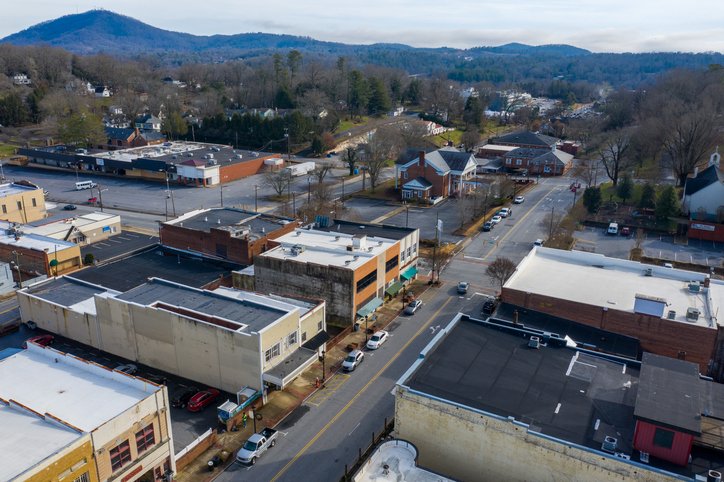
Connie Guinn is the mayor of Elk Park, a little town in Avery County, just a couple of miles from the North Carolina-Tennessee border on Highway 19E. It’s right by Roan Mountain, which Guinn pointed out from the mountain ridge where she lives. A few days ago, she got the keys to her completely rebuilt home, replacing the structure that was significantly damaged during Tropical Storm Helene two years ago.
On Sept. 27, 2024, the remnants of Hurricane Helene, reduced to tropical storm strength, struck Western North Carolina, eventually causing the death of 108 North Carolinians. Many more people lost their homes and livelihoods. Many people who lived in Western North Carolina when Helene hit have since relocated to other areas because of a myriad of reasons — housing and financial pressures being some of the foremost ones.
When Helene hit two years ago, the Elk River flooded 30 feet, which swept away and destroyed many homes in its immediate vicinity. There was one reported fatality in town, and seven across Avery County, a shocking number in a county of about 18,000 people.
Guinn wasn’t the mayor then, but she was heavily involved in the volunteer efforts. Her house wasn’t fully destroyed, but it was uninhabitable. Mud and debris had come down from up the mountain that their little neighborhood sits on and gotten up under her house. Guinn and Tommy returned to live in their home in the immediate aftermath of Helene, but they later discovered that there was black mold growing and that the home needed a new foundation.
She received some funds from the Federal Emergency Management Agency, or FEMA, but was later contacted by RENEW NC, the state Department of Commerce’s single-family home rebuilding program, last year about doing a full rebuild on her home, she told Carolina Public Press. RENEW is still continuing its long work across Western North Carolina, including four other homes in Avery County.
“The road is still bad in places down through there, down below Minneapolis,” Guinn said. Minneapolis is a small, unincorporated community in remote, mountainous Avery County that was heavily impacted by the storm. It’s one of a handful of communities in Avery that runs along the now-defunct East Tennessee-Western North Carolina Railroad, known better as “The Tweetsie.”

Guinn and her husband have been living in a short-term rental while her house has been under construction. They’ve been lucky enough to stay just down the road, she said. When she found out that she would be getting her home rebuilt so quickly, she couldn’t believe it.
She spent her career in local government, and when she retired, she got bored. So naturally, she ran for mayor in 2025 and was sworn in in December. She had spent her career working as the town clerk, but when she retired in 2023, she couldn’t stay away.
“I love this town,” she said. “My whole life’s been here and working for the town, my kids grew up here, and I just want to give back and just do the best I can do for the town.”
Guinn lived in her home, which is just up the road from town hall, for the past 33 years with her husband Tommy. She said she wants to preserve Elk Park’s small-town charm while keeping it relevant. She said she’d like to see a restaurant open up in town.

RENEW NC started work on her house last fall, and now, two years after Helene, she’s just waiting on the general contractor to sign off on the last couple of things before she moves back in, but she just got her keys to the home.
“I didn’t think it was real,” Guinn said.
Breaking down dollars
Helene damaged more than 73,000 homes across North Carolina, which cost about $15.4 billion, according to the state’s Office of State Budget and Management. North Carolina estimates that the storm cost nearly $60 billion in total damages — but federal and state funding toward the disaster has only covered about $14.4 billion. Federal funding for the disaster falls short compared to storms like Hurricane Katrina, where the federal government funded about 70% of recovery.
In Gov. Josh Stein’s June letter to North Carolina’s congressional delegation requesting $10 billion for Helene recovery, he wrote that $3 billion should go to unmet housing needs. At a campaign rally in Gastonia earlier this month, President Donald Trump joked that he would withhold remaining federal recovery funds from North Carolina if Republican candidate Michael Whatley does not win the upcoming Senate election. He later said he was just joking.
In March 2026, FEMA extended housing and rental assistance to Helene survivors until Sept. 30, when individuals living in temporary housing will have to relocate. Individuals who were still living in temporary FEMA housing in Helene-affected areas have been paying rent on a sliding scale since then, according to the agency’s website.
FEMA gives disaster assistance grants to help with repairs, which max out at $42,500. The average cost of rebuilding a home is around $276,285, according to the Governor’s Recovery Office of Western North Carolina, or GROW NC. RENEW is one of the quickest-moving programs of its kind in terms of rebuilding single-family homes during disaster recovery.
RENEW helps low- to moderate-income families and individuals rebuild their homes that were damaged by Helene. The program is funded by a community development block grant for disaster recovery (also called a CDBG-DR) from the U.S. Department of Housing and Urban Development.

“It has been so gratifying to see how quickly the federal government approved our HUD action plan and got money to the state, and how quickly folks were able to get their applications turned in and select contractors,” Scott Elliot, the deputy director of engagement for GROW, said. “It’s an amazing story of the good that the government can do.”
Families and individuals must make less than 120 percent of their area median income to qualify for the RENEW Single Family Housing Program. The program has 2,200 active applications and has currently completed 150 homes in Western North Carolina.
Many people who were affected by Helene don’t qualify for RENEW. The program has 5,696 ineligible or inactive applications, according to the program’s online dashboard. Applications for RENEW’s single-family housing program closed on Jan. 31 of this year. Funding gaps and the lack of insurance coverage for Helene damages have had a heavy economic burden on Helene survivors. Less than 1% of those affected by Helene had flood insurance.
A number of nonprofits and volunteer organizations, commonly known as Volunteer Organizations Active in Disaster, have avoided taking government funding for rebuilding efforts because of some of the red tape, hurdles and bureaucratic processes that come with construction. For instance, in order to repair a home damaged by Helene, government agencies must do extensive documentation on the ownership of a home before repairs even begin.
Red tape of rebuilding after Helene
Disaster recovery happens in long, slow phases. In the immediate weeks after Helene, efforts were focused on doing water rescues and getting water and food into the region quickly. Last year, efforts worked to stabilize the region’s utilities and infrastructure. Today, as homes are still being rebuilt, recovery efforts are pivoting toward building back with resilience.
Molly Maynard, the chief program officer at Pisgah Legal Services, has worked to help families navigate some of this red tape and help individuals and families find the best relief option for their rebuilding processes. Along with rebuilding through RENEW NC, some families can opt to have their homes bought out by the Hazard Mitigation Program, which is managed by FEMA at the federal level and the state Department of Public Safety.
“A lot of times barriers that people are facing are that they have lived in a home for a long time and acted as the owner of the home, but it is inherited property, for example, and there isn’t a record that reflects their ownership,” she said.
The CDBG-DR grant is one of the few disaster-relief grants that can also be used for multifamily housing. Some housing advocate groups, including Pisgah Legal Services, sent a letter to the Asheville City Council in May 2026 requesting that the remaining CDBG funds be focused on multifamily housing, rather than RENEW’s focus on single-family homes. But the council ultimately decided to allocate the remaining $19.2 million from the grant to the single-family program.
Maynard also said renters were left out of Helene relief advocacy. She said some people continued to pay rent on homes that had not been repaired, and that is still the case in some areas, despite the FEMA rental assistance that is ending soon. A big misconception about Helene is that recovery is done — there are people who are still in temporary housing and many who have not found a new normal, Maynard said.
“The way it’s set up, it almost assumes that because you didn’t own a house that got destroyed, you’re fine,” she said. “That’s just not the case.”
Extreme Weather Survivors is a national network that connects those who have experienced natural disasters, like Helene. Gina Heath is a community organizer with the group who was born, raised and still lives in Marshall in Madison County. After Helene, 25 of the 27 homes in her neighborhood near the French Broad River were destroyed. She did not lose her home, but lost property and utilities for her camper and was displaced for six months after the storm.
Heath said she thinks there have been minimal safety nets for those impacted by Helene. She’s seen some of her neighbors who have fallen through the funding gaps still live in trailers or in temporary housing. While FEMA maxes out at $42,500, some people with damaged or destroyed homes in Marshall got just a fraction of that.
“I did not hear any say, ‘Oh, I got a nice good FEMA check; that’s gonna really help,” she said. “I did not hear a single person say that even though I was on a street with homes that were completely destroyed.”
There are a number of nonprofits and religious organizations, such as Baptists on Mission, Samaritan’s Purse and the Appalachian Service Project, that have rebuilt homes that were damaged or destroyed during Helene. Baptists on Mission, an arm of the North Carolina Baptist Convention, has fully rebuilt 1,163 homes that were destroyed during Helene, with roughly 100 more in progress. Samaritan’s Purse, another Christian organization that is based in Boone, has rebuilt 300 homes damaged by Helene across Western North Carolina and Eastern Tennessee.
Some of these groups repaired homes in Heath’s neighborhood, along with a grassroots recovery movement in Madison County that has turned into the county’s long-term recovery group. These groups, which are now active in many Helene-affected counties, connect survivors of the storm with nonprofits that provide many different kinds of resources.
“If you didn’t have organizers on your street or in your holler with you, you might have fallen through the cracks,” she said.
Coming home after Helene
In Black Mountain, about a 20-minute drive east of Asheville, Vincent Groce is finally getting back into his home, thanks to RENEW. After living in a motel while his rebuild has been in progress, he’s excited about being able to cook his own meals in his own kitchen and be in his own space again.
“I’m ready to get home and get my stuff in here, get set up and clean,” he said. “I just come home and just enjoy the peace and quiet again.”

Like Guinn, Groce continued to live in his home in the months after Helene. Like Guinn, Groce is also a native of Western North Carolina and lived in his home for 12 years prior to Helene. He lives with his grandson and his dog. In the immediate aftermath of the flood, he traveled to Greensboro when I-40 reopened to stay with his daughter, but returned when power and water came back on.
But one day, his grandson, who lives with him, fell through the rotted flooring in his room on the other side of the home. He lives in a community of mobile homes — some of his neighbors have homes that still bear physical damage from Helene and others have had repairs completed.
On Sept. 18, Groce got to see his rebuilt home for the first time with members of the Governor’s Recovery Office and the RENEW team. Groce feels like the new home has lifted a burden, and he’s been trying to help others in his community awaiting repairs find resources, either through RENEW or other avenues, he said. Rebuilding is still continuing in Western North Carolina, no matter which group or agency is doing it.
“Thank you for all that you have endured and for just being a beacon and a model, and for everyone else, and to remind us of why we do what we do, ” Elliot told Groce. “Even though the government people would say this is short, it’s been two years.”
This article is republished from Carolina Public Press under a Creative Commons license. Read the original article.